This glossary is to comprehend the technical language used in the biotechnology field of study.
atom
noun
The basic unit of a chemical element.
Example: Lysozyme binds with a rather flat surface, except for the protrusion of a glutamine side chain into the antigen binding site, which is surrounded by three aromatic side chains and hydrogen bound to a carbonyl oxygen ATOM.
fr: Atome
Biotechnology
noun
The exploitation of biological processes for industrial and other purposes, especially the genetic manipulation of microorganisms for the production of antibiotics, hormones, etc.
Example: As result of the significant advances in BIOTECHNOLOGY and immunology, research is also being carried out to investigate the possible use of vaccines to harness the power of the immune system in the fight against breast cancer.
fr: biotechnologie
chemistry
noun
The branch of science that deals with the identification of the substances of which matter is composed; the investigation of their properties and the ways in which they interact, combine, and change; and the use of these processes to form new substances.
Example: Living radical polymerisation is a popular topic in macromolecular CHEMISTRY, as well as CHEMISTRY in general due to its applications in the materials industry. The combination of NMRP and ATRP could lead to new and specific polymers with great industrial potential, meaning this research is of great importance to the general community as well as the CHEMISTRY one.
fr: Chimie
electron
noun
A stable subatomic particle with a charge of negative electricity, found in all atoms and acting as the primary carrier of electricity in solids.
Example: However, differences are present in the numbers and types of ELECTRON carriers used and likewise the complexes pumping protons. Introduction The ELECTRON transport in respiration is a process by which ELECTRONs are transferred from an ELECTRON donor, such as NADH, to an ELECTRON acceptor, for example oxygen, through a sequence of membrane-associated ELECTRON carriers.
fr: électron
laboratory
noun
A room or building equipped for scientific experiments, research, or teaching, or for the manufacture of drugs or chemicals.
Example: The authors, researchers at the Biology Division of Oak Ridge National LABORATORY, USA., analysed karyotypes of 38 taxon of primates as a contribution to the scientific and taxonomic knowledge of the order.
fr: laboratoire
molecule
noun
A group of atoms bonded together, representing the smallest fundamental unit of a chemical compound that can take part in a chemical reaction.
Example: This means that this group within itself will be more compacted but it will not affect the overall shape of the MOLECULE and it does not affect the bond with the -carbon. 1e) Globular proteins are three dimensional structures that contain both secondary and tertiary structures.
fr: molécule
neutron
noun
A subatomic particle of about the same mass as a proton but without an electric charge, present in all atomic nuclei except those of ordinary hydrogen.
Example: Thompson discovered the negatively charged mass now known as the electron, but it was not for another fourteen years that the nucleus was detected and finally the proton and the NEUTRON in the 1930s.
fr: neutron
proton
noun
A stable subatomic particle occurring in all atomic nuclei, with a positive electric charge equal in magnitude to that of an electron, but of opposite sign.
Example: Recent studies, according to Fillingame et al . show that in Escherichia coli , there are 10 c subunits, and each has one essential amino acid that binds to a PROTON.
fr: proton
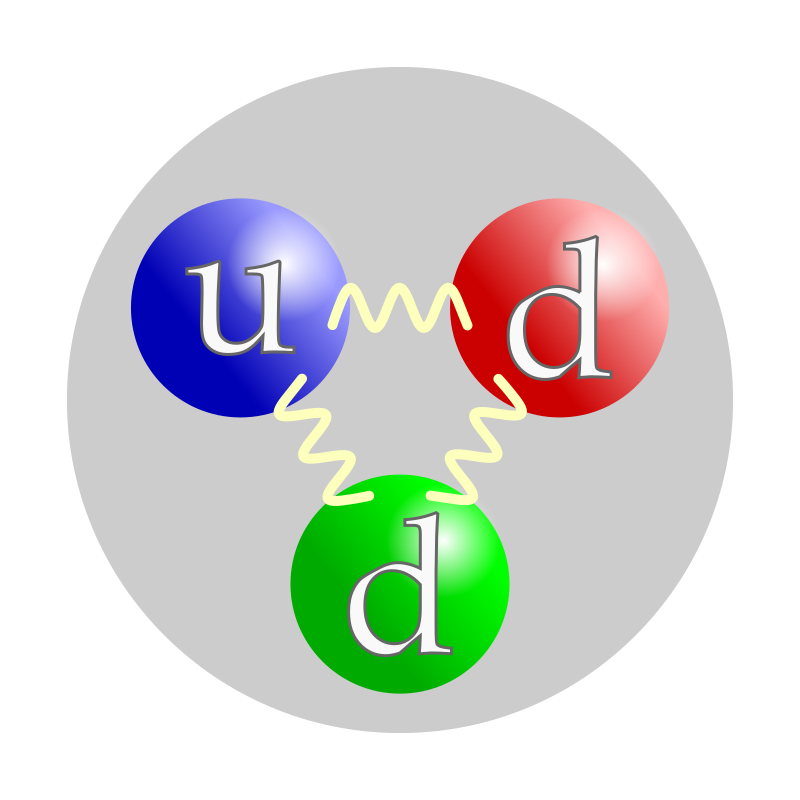
quark
noun
Any of a number of subatomic particles carrying a fractional electric charge, postulated as building blocks of the hadrons. Quarks have not been directly observed but theoretical predictions based on their existence have been confirmed experimentally.
Example: Although electrons are elementary, protons and neutrons are composed of even smaller particles known as QUARKs. There are six types of QUARK (known as up, down, charm, strange, bottom and top), and six types of lepton (electron, muon, tauon, electron neutrino, muon neutrino and tau neutrino), that make up the basic building blocks, known as fermions.
fr: quark
subatomic particle
noun
A particle smaller than an atom (e.g., a neutron) or a cluster of such particles (e.g., an alpha particle).
Example: He had discovered the first SUBATOMIC PARTICLE.